Wild Dogs in the Kenyan Highlands

Happy New Year everyone, we hope most of your dreams are realised this year and that you manage to keep most of your resolutions. One of our resolutions is to be better at keeping this Blog up to date as we have been told by some that they prefer the detail of the Blog to FaceBook. So starting the year with a bang, African Wild Dogs..... We are just back from hanging around a pack of African wild dogs up in the north of Kenya. We stayed at the Laikipia Wilderness Camp, owned and run by Annabelle and Steve who really gave us a great bush experience, and with their fantastic Samburu staff, helped us to spend alot of our time looking for and watching the dogs who continue to den nearby. Why do we love Wild Dogs so much? * Well, they are terrific socialisers and get very excited and affectionate toward each other when they greet, before they go hunting, when they return. * They then morph into efficient killing machines. They are quick, they hunt in small packs, they devour pretty much everything, bones included, within minutes, trying to beat hyenas or anything else wanting to nick their kill. * The adults regurgitate what they have eaten to feed the puppies or other dogs in the pack that haven't eaten. * It's adrenaline filled full-on exhilaration speeding around in an open safari vehicle, clinging to your camera gear with one hand to protect it and clinging to anything solid to protect yourself, as you try to keep up with the dogs as they are hunting. Too much fun! * And Wild Dogs don't grow on trees so whenever we can, we invest the time to get really good sightings of them. If you're interested in Wild Dog behaviour, we highly recommend staying at the Laikipia Wilderness Camp in Kenya where you will also be very well fed and watered, (possibly the best food in the bush!), and you will enjoy a very genuine, real bush experience as in this part of Kenya you have ranchers collaborating with small safari camps, cooperating with local communities, all on the same land. Quite a different experience.

We have seen Wild Dogs in Botswana and Tanzania (and India but they're not African!) In Laikipia the dogs, like the numerous pairs of Dik Diks and alot of the game in the highlands, are noticeably darker.
Catching glimpses of them hunting, mainly Dik Dik which are plentiful in the area...
Getting such a clear view of all the puppies outside their den bolt hole...
And how's this, the pups having a tug of war over the meat regurgitated by the adults!
Hope you enjoy these shots as much as we did taking them. Do get in touch if you would like help getting in touch with the Laikipia camp or any other info. Very best wishes for 2013. Julie and Adam January 2013

INCREDIBLE India! 25 March 2012

We have just returned and recovered from a really incredible trip to India. We visited a few new states; Gujarat to the West and Assam and Meghalaya in the far North East. We went back to Rajasthan for the Holi festival and passed through glorious Delhi on the way in and out again.

We will be publishing a trip report, youtube slideshow and some Facebook updates in due course, but for the time being this post will try to capture some of the highlights while fresh in our minds!

Holi

Holi is an ancient Indian festival known as the "Festival of Colours" and involves a tradition of covering anyone at home or out in the streets of India with lots of colours. This is the 3rd year we returned to Jaipur, the capital of Rajasthan, for the Elephant festival and the Holi colours.

The Elephant festival is held at the Polo ground and this year seemed to attract fewer elephants than the last two years. In any event, it is a chance to see Elephants painted with all sorts of colours:


There is a great competition by the men sitting on top of the elephants to look as regal as possible in the hope of winning one of the prizes. This guy with the flag did pretty well.


The next day the people of Jaipur go a little crazy playing Holi, the streets are full of people running about trying to cover each other with dye. Some would say we are foolish, but we love travelling about in an open Jeep built in the 1940s with our good friends Devendra and Praveen. No Health & Safety, no seat belts and no harm done at all!


You have two options with the dyes. Natural ones which are bright and relatively easy to wash off or chemical dyes which turn your face are more indelible black or dark shade!. Anyway, lots and lots of fun for everyone whether you are crowded on a motorbike:


In your car:


Or having a quiet walk in the streets:


The tourists with the right sense of humour really get stuck in:


And even those who had no intention of getting covered in colours can be encouraged to do so:


At the end of the day, to avoid annoying our hotel we like to use a garden hose to get rid of the worst of the dyes:


Gujarat

After Holi, it was a quick flight down to Gujarat to capture some of the festivals which some of the local tribes celebrate to continue the fun. The first was in the small town of Kavant. This is a gathering of the Rathva community to recreate the joy of existence and life. We arriving there and not much seemed to be happening. A daily empty street, a tattoo artist applying small tattoos for about £1 and which took about 30 seconds (no change of needle):


Then suddenly the town filled up with all sorts of people from many miles around. Crazy guys with a little too much makeup but great attitude:


Lots of girls, many of whom we understand are looking for prospective husbands:


And really energetic crowds with people shouting, singing and having a great time:


We thought this was pretty mad, but the next day it got even better. Another village and again starting very slowly. A few of the local men started off the morning with some of the local hooch:


But after a few hours, again thousands and thousands of people started to descend on the village either walking, or arriving on overloaded jeeps:


We thought something special was going to happen. Well it was a pretty unique ceremony in which some sort of priest was strapped to a large contraption:


Then someone else climbed on the other end of the contraption and it was spun round and round and round:


And this was after half a dozen chickens had their heads chopped off and a few people walked across some burning coals ...

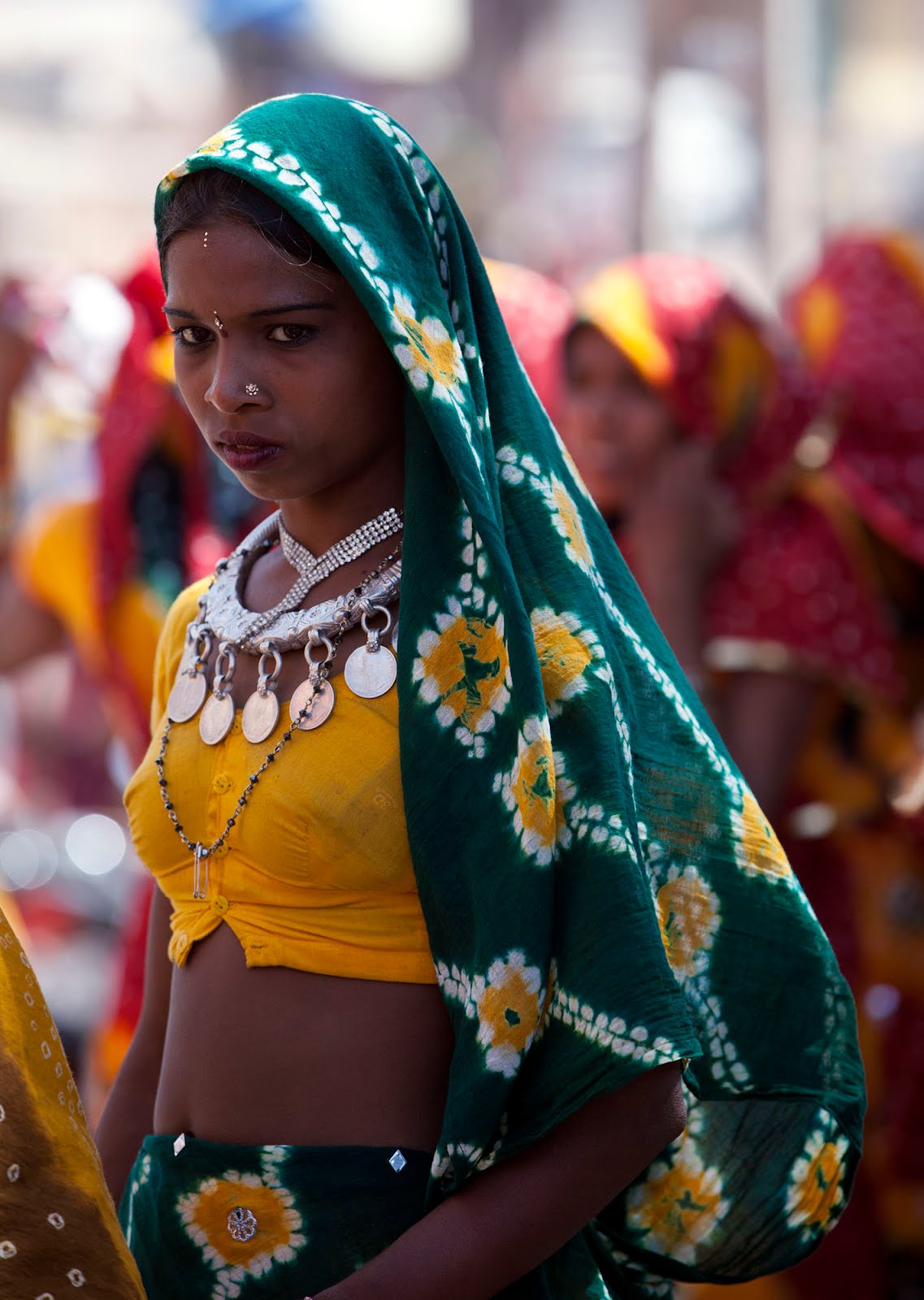
This was another chance to see some of the really great colours the girls wear:


And their nails:


And jewelery:


And men with their great moustaches:


Once we got out of the main cities, Gujarat was exceptional. The colour, the people, the festivals and the food. It exceeded all our expectations. Then a flight east to Kolkata and then north to Guwahati in the remote north east of India.

Living Root Bridges

The main reason for travelling so far was to see the Living Root Bridges. These are bridges across rivers which are made from the Indian Rubber tree (Ficus Elastica) and which are trained over many years to form a bridge. Quite extraordinary. We saw five or six of these over the couple of days we were based in the region. There were two that really impressed us. The first was a double decker! To say that this was not easy to get to was an understatement. We drove to the end of the road and a sign pointed down into a ravine. The good news was there there were concrete stairs. The bad news... there were 2,800 steps down and another 2,800 back up. Did we mention we were staying at Cherrapunjee which is the wettest place in the world?

It was well worth it to see this amazing fusion of nature and man.


The bridges are very sturdy and can easily take the weight of 10 men. They have stones placed along the bit you walk in and are a very natural structure.


We then travelled to what many regard as the most beautiful of the living root bridges at Mawlynnong. This was easier to walk to and was stunning:


When driving along in India there is always something to look at and often things that make us stop and get out!

Horses and their trainers in the desert:


People watering their animals:


Or people playing cricket with home made bats and balls!


What did this trip tell us? No matter how many times you visit the country there is always more to see. A festival, new wildlife or some wonderful scenery. The food is varied and if you are slightly brave there is always a new dish to try. And finally the people offer different tribes to get to know and they almost always love having their photographs taken.

Thank you India.

Julie and Adam

emails in the jungle - 15 January 2012

While out in Borneo we spend most of our time photographing Orangutans, processing our photos, eating or sleeping. Our phones and Julie's blackberry were not picking up any signals so we were without 24/7 contact ;-)

One day we went for a walk in the jungle and at the base found this. It was a wooden platform linked to a simple wire a hundred feet up in the canopy. To our amazement, when Julie put her Blackberry on the device it picked up a signal and started downloading emails. Amazing. No electronics, no power, just a simple wire.


Julie and Adam

Tablets in the jungle - 10 January 2012

We never thought we would see the day. Using mobiles phones for wildlife is one thing, using a tablet to make a video of Orangutans is another (well at least it was not an iPad. What next?


Julie and Adam

Orangutans in Borneo - slideshow - 8 January 2012

Here are some more shots from our December 2011 trip; plenty of Orangutans!


Enjoy!

Julie and Adam

Borneo Orangutans – 30 December 2011

We have just arrived back to Jakarta after 10 days on the Indonesian side of Borneo photographing Orangutans. We will publish a trip report, a YouTube slideshow and some more postings as soon as we can, but for now some immediate thoughts about the expedition.


First, getting there from Europe takes a bit of effort and time. We took Singapore Airlines to Singapore, on to Jakarta and from there another internal flight and boat, ending up at Tanjung Putting National Park. On the way, we took a slight diversion to see the amazing Buddhist temple/s at Bodupur and to get over at least some of our jet lag.


Secondly, for the best viewings and time with the Orangutans you live on a river boat. This is no 5 star luxury liner, but purpose built wooden boats with a guide, captain, cook and helper. We absolutely loved it and indeed found the food the best we had while in Indonesia. Sleeping in the open air with only a mosquito net between you and the jungle is a great experience. Early 6am starts were the norm with lights out often by 8pm!


Thirdly, it can be wet, very wet, no very very very wet! On our trip it rained every day, either for say 30 minutes or a couple of hours. For the second time in our Shutterspeeedtravel careers, one of the Canon 5D Mark IIs failed. It's electrics went mad and drained a battery in 10 minutes and then decided not to work. Lenses fogged up at times in the 100% humidity. But of course this did mean we could get some great shots of the Orangutans in the rain.


Or just after the Biblical rainfalls by which time the Orangutans' were absolutely soaked … as were we.


Fourthly, thanks to good advice from our friend Paul McKenzie of wildencounters.net we left behind our trusted 500mm and 600mm bazookas and most of our shooting was with either the 24-70mm or 70-200mm lenses, just because you get very close to these wonderful great apes. Downside of the forest is that it is pretty dark and if our Orangutans were up in the trees above us, we'd be shooting into a whiteout sky wherever there wasn't dark shadowy tree canopy. So most of the time we were shooting on 400 to 1,000 ISO. This sort of example of a young male was taken from three feet with the lens at 38mm. Fantastically close!


Finally, the experience with the Orangutans is very different to any of the other great Apes. Most of the time they are very calm, unlike Chimps or Bonobos. And their arboreal movement has to be seen to be believed. They are smooth, elegant and graceful, defying gravity and like none of the other great apes. This trip marks for us the seeing of the last of the great ones and we feel truly privileged. All very special, in their own way but regrettably within 50 years tops, some of them will only be subjects of history.

If you're really lucky, you can spend hours with the Orangutans, unlike say the Mountain or Lowland Gorillas where you are restricted to one hour.

Most of the time we were seeing females with young babies.


At other times it was great trying to capture the young as they were clambouring up in the trees.


On occasion the dominant males would appear and they were a few dress sizes bigger then anything else around … and they knew it! In this case "Big Tom" who at 225kg is no lightweight.


And Adam always likes getting in close to capture portraits of these amazing creatures.


And of course there were other primates around. Gibbons and Proboscis monkeys were our favorites. The Proboscis monkeys would gather every evening on top of the trees by the river jumping around. Blessed with noses and vocals not seen on any other creature thankfully:)


A really special experience. One other point; we found the Indonesian people really friendly and loved having their pictures taken. For the first time in many years we were asked time and time again to have our photographs taken with local people.

More to follow but in the meantime, Happy New Year to all our friends! Despite the numerous challenges facing our world, may 2012 be safe, happy and prosperous.

Julie and Adam ;-)

Free The Children - Kenya 24 November 2011

Just a snapshot of our group volunteering in the Masai Mara recently. The "Free The Children" charity does fantastic work in the communities and volunteering is a rewarding experience. GET INVOLVED!!!


Julie